Project Overview
This project adapts FLUX.1 to generate retro pixel-art characters with clean silhouettes and limited palettes. The goal was a reusable LoRA workflow for game assets and fast prototyping.
Examples
Three local examples from the workflow:
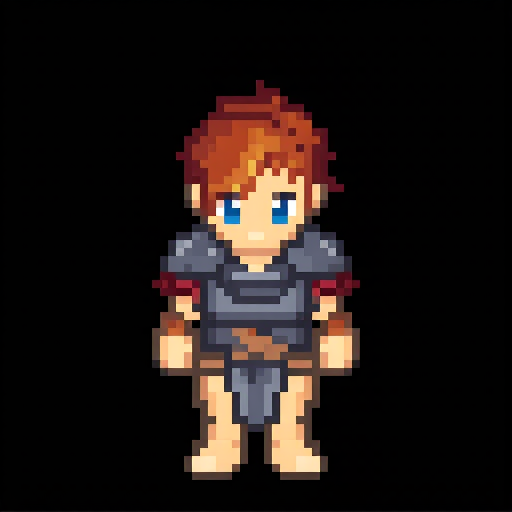
pixel art character, red hair, gray armor, no weapon, facing forward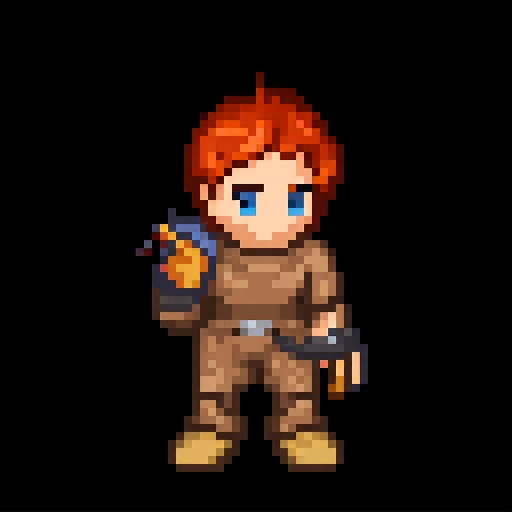
pixel art character, red hair, brown armor, no weapon, facing forward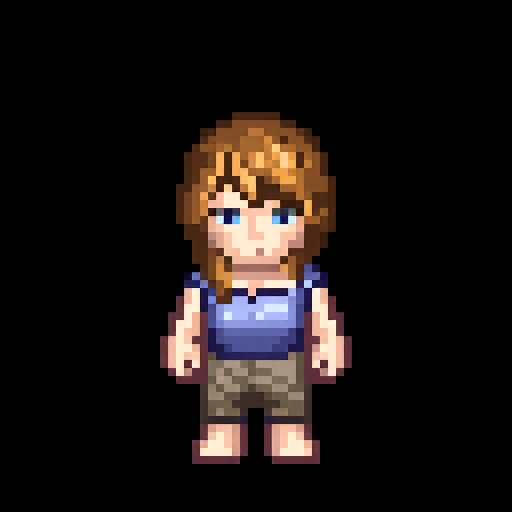
pixel art character, brown hair, blue clothing, no weapon, facing forwardQuickstart
This is the core Diffusers setup used to load the base FLUX model and the LoRA adapter:
import torch
from diffusers import FluxPipeline

pipe = FluxPipeline.from_pretrained(
    "black-forest-labs/FLUX.1-dev",
    torch_dtype=torch.float16
).to("cuda")

pipe.load_lora_weights("milliyin/pixel_art_characters_lora_flux_nf4")

prompt = "pixel art, rpg adventurer, green cloak, clean outline, limited palette, facing forward"
image = pipe(
    prompt=prompt,
    negative_prompt="blurry, low quality, distorted, ugly",
    height=512,
    width=512,
    guidance_scale=7.5,
    num_inference_steps=50,
).images[0]

image.save("sample.png")
Prompting Tips
- Use compact prompts like
pixel art, [role/class], [palette cue], facing forward - Add presentation cues such as
clean outline,limited palette,8-bit, orsprite sheet style - Use a negative prompt to suppress blur, noise, distortion, and photographic artifacts
Non-Technical Overview
- What this is: A small LoRA add-on that teaches FLUX how to draw pixel-art characters
- Why LoRA: It changes the style without retraining the full base model, so the workflow is faster and cheaper
- What you need: The base FLUX model, the LoRA adapter, and a short prompt
- Who it helps: Indie developers, artists, and prototypers who want consistent characters quickly
Technical Details
Data Pipeline
- Dataset:
haidarazmi/lora-pixel-art-characters-datases - Resolution:
512x512with resize and random crop - Conditioning: precomputed text embeddings loaded from Parquet and aligned by image hash
- Batch strategy:
train_batch_size = 1with gradient accumulation to avoid out-of-memory issues
Model & Adapters
- Base model:
black-forest-labs/FLUX.1-dev - Trainable layers: attention adapters in
to_q,to_k,to_v, andto_out.0 - LoRA rank:
r = 4 - Quantization: NF4 via bitsandbytes to reduce VRAM during training
Objective & Scheduler
- Scheduler:
FlowMatchEulerDiscreteScheduler - Loss: weighted MSE on the velocity target
- Guidance: pooled and text embeddings for conditioning
Optimizer & Precision
- Optimizer:
AdamW8bit - Learning rate:
1e-4 - Precision: FP16 mixed precision
- Gradient clipping:
1.0
Latent Caching
Encoded latents are cached once with the VAE, then the VAE is freed so the rest of training can reuse those latents without repeating expensive encoding work.
Key Hyperparameters
width=512, height=512
rank=4
learning_rate=1e-4
train_batch_size=1
gradient_accumulation_steps=4
max_train_steps=700
mixed_precision=fp16
checkpointing_steps=100
guidance_scale=1.0
device=NVIDIA A100
Evaluation & Results
- Goal: stylistic consistency, clean silhouettes, and readable armor or clothing at 1x zoom
- What worked best: prompts around 5 to 15 tokens produced the most stable sprite-like outputs
- Failure cases: long prompts drifted toward full-frame art, while very high guidance introduced aliasing and non-pixel textures
The biggest win here was consistency. The model stayed much closer to the intended sprite style once the prompt stayed short and the LoRA handled the style specialization.
Limitations
- The style is tuned mostly for single, front-facing characters
- It may reproduce dataset biases in pose, attire, and palette choices
- The original dataset/license constraints matter for usage decisions
Plain-English Walkthrough
- Start from FLUX, which is the base image model.
- Add a small LoRA adapter that learns pixel-art rules.
- Feed it many labeled pixel-art characters.
- Let the adapter learn the recurring style patterns.
- Load FLUX plus the adapter later and generate new characters from short prompts.
Why It Matters
This project turns style tuning into something practical and reusable. Instead of retraining a full model, it shows how a compact LoRA can produce a consistent visual style that is actually usable for game-art style outputs and quick creative iteration.
Links
- Adapter: milliyin/pixel_art_characters_lora_flux_nf4
- Source code: milliyin/Flux.1-In-Context-Learning
What I Learned
This project reinforced a few practical lessons:
- shorter prompts usually outperform over-detailed prompting in style-tuned image workflows
- LoRA training becomes much more useful when the evaluation is systematic
- latent caching and compact adapters make experimentation much cheaper
- image generation quality depends on both training discipline and prompt discipline